Showing posts with label The Beatles. Show all posts

Wednesday, March 14, 2012

Rock & Taxes: A Treasury of the Whiny Rich

The tax man's taken all my dough,
And left me in my stately home,
Lazing on a sunny afternoon.
And I can't sail my yacht,
He's taken everything I've got,
All I've got's this sunny afternoon.
 
So sang The Kinks' Ray Davies in 1966, in "Sunny Afternoon." That was the same year that George Harrison kvetched about the taxman taking 95% of his income. There was quite a bit of artistic license in these gripes from newly wealthy rock stars.

It turns out Davies and Harrison weren't the only classic rock legends with money on their mind. Indeed, nearly every British classic rock band of the 60's and 70's has tussled with taxes in song or in their lives. It's astounding, actually, the lengths to which these groups--all of these groups--went to complain about paying taxes and protect their assets.

For a genre that reveled in revolutions in consciousness, politics and sex, it was an unusually conservative stance. In more ways than one, these guys had regressive attitudes towards tax policy.

Many of these acts were happy to take on the mantle of the working man. They just didn't want to help pay for his health care, his children's education, or his public transit. And why would they, when there were mansions to buy. So who were these tax-averse Brits?
  • The Beatles--George Harrison's "Taxman" has become an iconic song to American conservatives, and not for its richeous Paul McCartney guitar solo. Bob Dole used it in his 1996 campaign, and online you can find organizations like Americans for Tax Reform claiming that taxes broke up the Beatles. Harrison and Ringo Starr both chose to leave the UK in the 1970s as "tax exiles."
  • The Rolling Stones--The Stones fled England in the early 70's, penniless, to escape onerous british taxes. That's the story Mick and Keith tell about how the Stones wound up recording their 1973 classic Exile On Main Street in a French Chateau. But, if the Stones ever had real problems with taxes, those days are long behind them. Between 1986 and 2006 they paid just 1.6 percent in tax on hundreds of millions of pounds in income.
  • Rod Stewart--Probably the second most famous tax exile on this list. Stewart's "Atlantic crossing" to Los Angeles came as his solo success eclipsed The Faces' profile. According to Stewart, taxes had made it "not worth living in England any more." 
  • Pink Floyd--The Floyd spent the entirety of 1978 abroad, for tax purposes. This seems to have been a more important concern than visiting Syd Barrett. Roger Waters has changed his tune on taxation since, and is currently promoting himself as a pro-Occupy musician.
  • Led Zeppelin--Taking their accountants' advice, Led Zep left the UK for 1975 as tax exiles. During this time, Jimmy Page would screen his answers to questions in interviews, to make sure they didn't jepordize his tax status. And Robert Plant was whisked out of the country shortly after a serious car accident, so that Led Zep's tax status wasn't affected.
  • The Who--The quartet went on their own 1970s tax exile. Bassist John Entwistle's song "Success Story" contained the lyrics: "Away for the weekend/I've gotta play some one-night stands/Six for the tax man and one for the band." Sounding a different note, Roger Daltry recently criticized U2's efforts to dodge taxes in Ireland.
  • David Bowie--Bowie kicked off his "Berlin period" by moving to Switzerland--a decision motivated, in part, by the desire to avoid British tax rates.
This is hardly a complete list. The next generation, including Sting, Phil Collins, Ozzy Osbourne and Queen, carried on the tradition of tax-dodging. More recently, Adele claimed her tax bill made her want to "go and buy a gun and randomly open fire."

So what is it with Brits and taxes? American musicians haven't made a similar stink about taxes, and anti-tax sentiment is far higher in the US.* Of course, British tax rates are somewhat higher. But structuring your life to avoid paying taxes--as all the above artists have done--is about the least rock and roll thing you can do. Seriously, even Drake is cooler on the subject of taxes than Jagger, Bowie or Page.

In a definitive article on this subject, Simon Firth chides tax exiles for not taking advantage of a great number of options for reducing their tax bills in the UK. He also makes the point that taxes apparently don't pose a threat to artistic innovation, as free market fetishists might claim.

And let's talk about that term--tax exile. Exile is a strong word. Musicians have been exiles before: Caetano Veloso and Gilberto Gil had to leave their native Brazil for England, to escape political persecuption. Arnold Schoenberg was driven from Germany by the Nazis. These are not remotely similar to the situation that Led Zeppelin faced. Tax exile is a histrionic turn of phrase for millionaires who want to keep more money to themselves. These wealthy Brits haven't been persecuted or exiled out of principle. They were just greedy.


*American musicians do complain, sometimes. Take Big Boi's verse in "Gasoline Dreams," where he complains that even though he has the key to the city, "I still got to pay my taxes and they give us no pity."

Friday, February 24, 2012

The Beatles and R&B

It's not news that the Beatles began their recording career heavily indebted to black American music. Early rock and roll, R&B and the blues were all important ingredients of their sound, as Anglicized as it was (the Beatles were probably less shameless in their appropriation of these genres than most of their peers). Anyways, a quick listen to their earlier recordings, or glance at the covers they recorded, reveals that R&B had made an impact in Liverpool.

However, as I've been immersing myself in R&B this past year, I've been surprised by the extent to which the influence was mutual--the Beatles' influence is clearly felt in R&B. Not in cover versions, although legends like Ray Charles, Wilson Pickett and Aretha Franklin all covered Lennon/McCartney tunes during the 1960s.

The Beatles weren't influencing R&B during the early 60's--when they themselves were aping the genre. It was only after the band left behind their early, more insistently rhythmic music that the influence filtered back. It was the studio-based, baroque and psychedelic Beatles--the Beatles of "Tomorrow Never Knows" and "Strawberry Fields Forever"--whose music altered American R&B.

It was connecting a couple anecdotes that led me to recognize R&B's embrace of the Beatles. The first was about Otis Redding. In the months before his death, Redding became obsessed with Sgt. Pepper's. He had previously covered the Beatles,* but this was different. He channeled Pepper's psychedelic sounds in writing "(Sittin' On) The Dock Of A Bay"--a song whose pensive beauty resembles "Strawberry Fields Forever." "Dock Of A Bay" was drastically different from anything Redding had previously written. Different enough that Stax was reluctant to release it at all. Otis, of course, knew better: he predicted the song was a number one hit, although he didn't live long enough to see that come true himself.

A couple years later at Stax, Booker T found himself so inspired by Abbey Road that he and the MG's recorded an entire album of Abbey Road covers. They called it McLemore Avenue--where the Stax studio was--and that's the album cover, at the top of the post.

The second anecdote is about Richard Pegue, a Chicago DJ who ran the Nickel and Penny record labels. The wonderful work of Pegue's labels was recently excavated by the Numero Group. In that release's liner notes, it mentions that Pegue's record collection featured lots of British Pop, including several Beatles LPs. The influence is clear on some of the later cuts on the reissue, when Pegue began using colorful production techniques in his R&B.

This was more broadly true of R&B acts. Stevie Wonder--who hit number one with a cover of "We Can Work It Out" in 1970--took the studio-as-instrument and synthesizer to astounding places. These were sounds that the Beatles and producer George Martin helped introduce into the pop vocabulary. Stevie's Motown colleague  Norman Whitfield, in his work with the Temptations and the Undisputed Truth, was transforming R&B into something as psychedelic as anything from Magical Mystery Tour.

By the early 70's studio experimentation had taken firmly taken hold in R&B. So had the album format, as opposed to the barrage of singles. Credit to that goes to Isaac Hayes more than the Beatles. But it's clear that Hayes was listening to the Beatles--he does a ten-minute version of "Something" on the brilliant Isaac Hayes Movement, and his sophisticated arrangements and multipart songs recall Abbey Road's medley.

I don't want to overstate this case. Psychedelic ideas were in the air. The Beatles were a gateway to those sounds for music fans like Richard Pegue, others in the R&B world. But they weren't the only one (Sly & the Family Stone were another crucial gateway group). And the Beatles were hardly the main influence on late 60's and early 70's R&B. That'd be James Brown, who flipped the Fab Four's trajectory on its head and placed all his emphasis on the rhythm.

But it's a story with a nice circularity. That the Beatles, the world's biggest and most revered rock band, were able to inspire a few new sounds in a genre from which they took so much.


*The Beatles, for their part, had shown their admiration by sending limos to pick up Otis and other Stax performers from the airport during a British tour. And--though this seems ridiculous and it's hard to find documentation for this--Wikipedia and other sites report that the Beatles bowed and kissed the ring of Stax guitarist Steve Cropper.

Wednesday, February 17, 2010

Hey Guys, Catholics Can Drink the Kool-Aid Too!

L'Osservatore Romano, the Holy See's inside source for all things Pope-related, has been doing its part in recent months to rehabilitate the Catholic Church's public image, particularly when it comes to the Church's history of opposing adult themes in popular media such as music, film and literature. As we know, though, even Bishops have to eat occasionally. What do do when you're a Catholic newspaper that wants more blog traffic? Well, the first thing you do is write an article calling Avatar overrated. And, like that other magazine catering to the whims and prejudices of those who have let modern culture pass them by, they know that nothing redirects web traffic like a numbered list.

In this case, L'Osservatore has determined the ten best pop albums of all time. The resulting list is way more interesting than Rolling Stone's. But are these really the sort of jams Pope Benedict should be kicking out to while going through his morning prayer-and-hat-shopping routine? Ladies and gentlemen, I give you the newly installed eighth sacrament of the Catholic Church: Rock music!

1. The Beatles, Revolver. It makes sense that the Catholic Church would be about ten years behind VH1 in choosing the exact same contender for best album ever. Of course, Revolver ranks among the four or five greatest Beatles albums (I have always slightly favored the White Album over the rest), and therefore belongs somewhere on this list. As far as Catholic bona fides go, George Harrison's "Taxman" rejects government taxation without explicitly calling for the Church as an alternative; "Eleanor Rigby" could be used as an unofficial theme song for Catholic liberalism, which doesn't really gibe with the Reign of Benedict; "I'm Only Sleeping" subtly illustrates the Catholic work ethic; "Tomorrow Never Knows" is about drugs, and how awesome they are. Lennon's vocals for "Tomorrow Never Knows" would work well as a Gregorian chant, though.

2. Pink Floyd, Dark Side Of The Moon. L'Osservatore was wise not to choose the explicitly anti-authoritian and anti-organized religion albums The Wall and Animals; similarly, the narrative of Wish You Were Here includes songs lauding acid burnouts and condemning capitalism. Piper is too schizophrenic, and has songs about Lucifer, and Meddle is too bass-heavy. Dark Side is the safe choice by comparison, and it tackles some big, religious subjects. But does anyone in the Church have the gall to support songs calling money the "root of all evil today?" This is probably the pet favorite of Vatican astronomers.

3. Oasis, What's The Story (Morning Glory?). Apparently the Catholic Church has finally taken sides in the Britpop wars. I'm fully prepared to begrudge this, picking a middling album from a band whose reputation for childish antics far exceeding their songwriting. Perhaps they like Oasis because their lyrics are so confused, lacking any remote form or subject, that there's no way one could cull any sort of anti-religious message, or any message at all. Britpop fans and Catholics are alike in that respect.

4. Michael Jackson, Thriller. This makes sense. The title track, and its accompanying video, serve as an amusing throwback to the Hollywood reign of Father Daniel Lord and Hays Code horror movies (where no one is brutally murdered, except offscreen, and monsters tend to run around looking terrifying as opposed to dishing out wanton slaughter and gore). L'Osservatore says that they like the "illuminating simplicity and musical thrust" of the album, and they might as well be right: if they wanted to get away with a pop album that was as sexless as it is ubiquitous, they made the right choice.

5. U2, Achtung Baby. U2 was a sure shot for this list, but what do we make of their choosing Achtung Baby over The Joshua Tree? Only that they're interchangeable, for the purposes of staking out one's dubious claim of being a fan of alternative rock. It's worth noting that Bono, the Edge, and Larry Mullen, Jr. were (are?) all evangelical Christians.

6. Fleetwood Mac, Rumours. This is basically an album about how infuriating adultery can be, and how insufferable it can make you when you decide to write songs about the people you work with. The Vatican understands that Fleetwood Mac were no paragons of virtue, but ranting about infidelity, when accompanied by smooth grooves, surely rings of condemnation. I'm one of those people that prefers them with Peter Green, but I realize that Rumours better fits a narrative at once popular and moral-ish.

7. Donald Fagen, The Nightfly. My personal favorite choice here, mainly because I love imagining the conversation that went into it. What I think happened was that the Vatican has some major Steely Dan fans that nevertheless may have had problems with their dark sarcastic lyrics, so they decided to look further into the oeuvre of Dan and found this classic to be less dark and sarcastic by comparison. The Nightfly may have the first (and last) instance of an unabashed love song in the Dan catalog, "Walk Between Raindrops," and some of the other songs ("I.G.Y.," "New Frontier") could, at first glance, be less sarcastic than their predecessors. In any case, any person or group that lists this album at No. 7 is automatically cool in my book, no matter how they choose to pad the rest of it. Even Santana.

8. Santana, Supernatural. Others may find this appalling, when Abraxas is so clearly the superior choice. Is it, though? I find myself unable to care, but color me disappointed that the Vatican adds itself to the list of institutions propagating this myth that Carlos Santana is the world's preeminent guitar legend. Not an egregious sin, but a sin nonetheless.

9. Paul Simon, Graceland. Of all the articles I have ever written on the Internet, none have caused so much continual negative feedback as this particular post I wrote on Paul Simon. I will still get an email or so every couple of months admonishing me for my obvious jealousy, lack of talent, ignorance, etc. So I don't have much more to say about Paul Simon. While I still can't see what some people get about Graceland, at least the Vatican didn't choose Still Crazy After All These Years.

10. David Crosby, If I Could Only Remember My Name. My theory: The Magisterium contains many a closet CSNY fan, but if you only have one slot left, which do you choose? Stephen Stills is a rockin' multi-instrumentalist, but he was also a Democratic delegate for Florida during the 2000 election; Graham Nash has been in many great bands, but he's also a complete fruitcake, and he's been know to collaborate with a-ha; Neil Young is a Canadian lefty who sometimes distorts his electric guitar. Crosby is, by elimination, the safe choice.

Many thanks to the Vatican for inspiring me to listen to my first David Crosby solo album. Will we see more lists of its like? That depends on whether the Church continues to take its cues from the Pope and use its power for censorship, or whether it comes to see that there's nothing wrong with a religion that embraces culture of New, rather than trying to regulate it. I hope it won't be the former, because that would be some papal BULLSHIT.

UPDATE: Apologies to Greg for probably misrepresenting the church he used to attend before he grew up and came to know better. Happy Ash Wednesday!

Sunday, November 15, 2009

Love It To Death

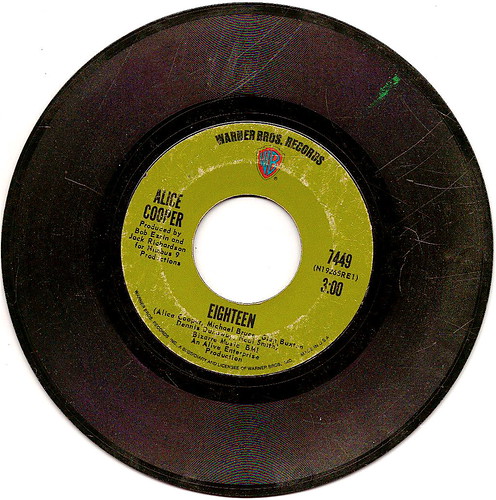
I was delighted to find this recently, and not because it's especially good. It's a Replacements cover of an Alice Cooper tune, and it literalized a realization that I'd been stumbling towards for the past couple months--that the great Alice Cooper song "I'm Eighteen" provided a blueprint for The Replacements.

I'm no Cooper expert--the early 70's work seems to get love--but I always associated the guy with cheesiness. Cheesy rock songs, cheesy makeup, cheesy movie cameos, cheesy everything. It seemed like an act designed to exploit adolescent boys.

But "Eighteen" is another matter. If you haven't heard it recently, take another listen (this six-minute version is the one you want to hear, and the one I'll discuss). It's a beast of a song. Cooper and guitarists Glen Buxton and Michael Bruce aim for the jugular and annihilate it. The central riff is unreasonably epic, and the wild soloing sounds like an electrical storm. Weather metaphors are all I can come up with to describe the mood--it sounds like clouds scraping the sky, lightning with nowhere to strike.

And Cooper nails the vocals. He doesn't start until almost a minute in, when he begins raging wordlessly. The first line is perfect: "I got to get out of this place." His solution, "running in outer space," isn't great, but then there's no escaping teenage angst when you're in the thick of it. The narrator's embrace of his adolescence--he doesn't just like being eighteen, he loves it--is the most ambiguous lyric, but Cooper's delivery strongly suggests that this embrace is a misanthropic one. Indeed, in spite of its attendant problems, the hormones that dominate an eighteen year-old boy do make him feel very much alive. And "I'm Eighteen" crackles with uncommon vitality, all these years later.

Fans of Cooper's contemporaries Big Star would do well to give "I'm Eighteen" a listen. The song turns Chilton and Bell's youthful melancholy inside out, lashing out with no clear target. Chilton only ever sounded like a threat to himself, but Cooper sounds like a menace to society.

Both artists were working against the grain, however, by retaining as their subject matter the lives of American teenagers. By the early 1970's most of rock and roll had left behind the puppy love and heartbreak of doo-wop and early 60's pop in favor of more "mature" fare. Think about The Beatles: everything about the band had transformed radically between Please Please Me and Abbey Road, and the Fab Four were a bellwether throughout their career.* The years after their break-up saw a proliferation of singer-songwriters and politically conscious R&B stars, now somewhat freer to release what they wanted. In any case, a lot of the albums we valorize from that era sound like they were made for adults.

Alice Cooper and Big Star weren't making music for adults. Still, their songwriting benefited from the growing up of rock. Both bands' visions of adolescence were grim--a wounded rage, in Cooper's case, a deep melancholy, in Big Star's--in a way that songs rarely had been.

Both of these qualities would later manifest themselves in Paul Westerberg's songwriting (with a big assist, one presumes, from Peter Jesperson). The Cooper connection is undeniable. The wildcat guitar on "I'm Eighteen" actually sounds like Bob Stinson, and may well have influenced him. The lyrics on "Eighteen" too sound like a direct predecessor to The Replacements. One of the reasons I've dismissed Cooper is that he frequently sounds like he's playacting. Not so here: he plays his part in "Eighteen" with such conviction and reckless abandon that I'm convinced The Birthday Party were listening. But that's off-topic. I hear something of the confrontational but hurt "Unsatsified" in "Eighteen." As a lyricist, Westerberg followed Chilton much more vocally, but it's Cooper who animates his earlier, angrier work.

Paul Westerberg would also, of course, pen some startlingly original and true rock and roll, but everything has roots. The real-time molotov cocktail of "I'm Eighteen" is one root. It's also a fantastic song in its own right.

*The mere existence of James Brown disproves this assertion, but it's true enough to function as an example here

Saturday, September 19, 2009

Electric Arguments

It's hard not to get excited about the Beatles reissues, even if much of the attendant press has been atrocious.* By almost every account, the remasters sound brilliant, and I'm dying to hear them, if a few dollars short of the $300 price tag on the Mono Box.

The project has been an interesting look at what remains canon for the Beatles. The news isn't big--the UK versions of Rubber Soul and Revolver remain definitive, the LP-length US Magical Mystery Tour gets the nod, that Christmas compilation is ignored (but unlockable in Beatles: Rock Band), Anthology versions are absent--but I was sad to see that the Red and Blue albums weren't remastered. As a refresher: the Red and Blue albums, officially known as 1962-1966 and 1967-1970, were a pair of 2 LP best-of's released in 1973. They ran through the Beatles music in more or less the order that a pop-conscious listener would have heard the songs.

They have their shortcomings, sure: Pre-Rubber Soul material gets the short shift; the White Album gets three songs (10% of the album) to Rubber Soul's six (43%), while Revolver is represented only by "Eleanor Rigby" and "Yellow Submarine" (14%); the sequencing is chronological, except when it's not; and of course you could argue with the song selection. Personally, I'm astounded McCartney allowed the string-laden "Long And Winding Road"--which he detests--to close the Blue album. Why not close things out with "You Know My Name (Look Up The Number)", the last Beatles song released at that point, a track the band had worked on for years, and a tune that showcases the Beatles influences and goofy brilliance? Alas, the Red and Blue albums don't challenge listeners with obscure cuts.

But the Red and Blue LPs represent just about the best way to listen to the Beatles. These days, you could easily assemble a playlist of your favorite Beatles tracks, but I challenge you to come up with a collection of tunes that coheres and flows as beautifully as either of these:
Red album, side two: "A Hard Day's Night," "And I Love Her," "Eight Days A Week," "I Feel Fine," "Ticket To Ride," "Yesterday."

Blue album, side two: "I Am The Walrus," "Hello Goodbye," "The Fool On The Hill," "Magical Mystery Tour," "Lady Madonna," "Hey Jude," "Revolution."
I still listen to those songs, in that order, when I need a pick me up. I don't think I'll stop any time soon.

In other news, it looks like Rutles fans will be waiting a while longer for the Mononucleosis Box Set.


*The awfulness of the Times' Rock Band piece, authored by black hole of insight and video game critic Seth Schiesel, and the Star Tribune's review of the remasters, written by some guy called Chris Riemenschneider who managed to land a gig at the once-respected newspaper, is so apparent I need only link to them. The latter is particularly hilarious, and inspiration for a feature on this blog I may or may not follow through with. It'd be called "Review Of Reviews," in debt to a brilliantly-titled journal of the 1890s, and would be exactly what it claimed to be.

Saturday, August 15, 2009

Trip To The Store

Temporarily in possession of a car last Tuesday, and without much to do, I drove myself to Minneapolis' Cheapo Records. There's a Cheapo four blocks from my apartment in St. Paul, but the Minneapolis branch is bigger, cooler, and, crucially, has a basement "Viynltopia." I blew an afternoon and a few dollars there, here's what I found:

Isaac Hayes, The Isaac Hayes Movement--Ike's at the height of his powers on this album of four lengthy covers. As a songwriter, he's part proto-hop-hip visionary, part master arranger and interpreter. He picks apart his source material, shuffling around and recombining an original's lyrics, melodies, and rhythms with his own words and arrangements. He often sees enough in a song to stretch it to three or four times its original running length. Accordingly, the bittersweet album opener "I Stand Accused" gains a five-minute spoken word intro in which Ike, speaking to his best friend's fiancee, says everything but what he really means--that he's in love with her. As the song transitions from the intro to the bulk of the tune, the sparse drums, piano, and guitar gradually gain strings, horns, and a gospel choir in a build that would make Jason Pierce jealous. Jerry Butler's lyrics, as sung by Hayes, are an affecting and desperate plea for love, all the more potent for following the Hayes-penned monologue.

The rest of the album is hardly a let-down. Side one's other track, "One Big Unhappy Family," can't quite compete with the twelve-minute "Accused," but Hayes' baritone sounds wounded there as well, and carries the song. As an interpretive vocalist, his only true contemporary was Rod Stewart (who the same year would release his great, mostly-covers album Gasoline Alley). Side two begins with the Bacharach/David tune "I Just Don't Know What To Do With Myself." I hear it as the lament of "I Stand Accused"'s protagonist, after he wins and then loses the girl. The song's been drastically reconfigured, at least in comparison to the (also excellent) White Stripes cover I know, with an oddly lovely passage that features the gospel choir singing "Don't know what to do" in progressively higher registers.

The album closes with a 11:45 cover of The Beatles' "Something." While the guitar sounds eerily like George Harrison's, the song's sufficiently different to discourage comparison: let's just say they're both gorgeous. John Blair's contributions on violin nearly steal the song. 5/5

Low, "Santa's Coming Over b/w The Coming Of Jah"--Low's eerie UK-only Christmas single from last year. The packaging's cool--you can barely make out Low's name on the all-white cover--and the song's a grower. Creepy, quiet verses erupt into loud, nervous choruses. Deeply unsettling, even for Low. The b-side, a cover, is an attempt to merge Low's sound with reggae, a genre Alan's been name-checking for a while. It doesn't quite succeed, and that Al and Mimi invited their grade-school children to sing on the track doesn't help. 4/5

R.E.M., "Radio Song b/w Love Is All Around"--The song's got it's haters, but I've always enjoyed the upbeat, KRS-One-featuring "Radio Song." I bought this for the b-side, however, and I dig it. Mike Mills' vocals and Peter Buck's guitar render this delicate song even more fragile. Not as good as The Troggs version, still cool. 4/5

Charlotte Hatherley, "Summer b/w Commodore, S.M.U.T."--Hatherley's "White" is one of the best songs of 2009, and I enjoyed what I heard of 2007's The Deep Blue. "Summer" is culled from her first solo album. Power-pop sadly bereft of the fluid guitar work she's capable of, the A-side is enjoyable enough. The two b-sides are forgettable. 3/5

David Vandervelde, "Jacket b/w Murder in Michigan"--Vandervelde has a serious Marc Bolan fixation, but since when was that a crime? I bought this because it was cheap and had loved another T. Rex-biting tune of Vandervelde's, the towering, youthful "Nothin' No." "Jacket" works the same angle, to awesome, glam-tastic effect. The b-side is more "Ride A White Swan" than "Jeepster", and less fun. 4/5